A roof does much more than protect a building from rain and sunlight. It needs to withstand changing weather conditions, manage heat, resist corrosion, retain its appearance and deliver reliable performance for years.
That is why selecting the right roofing sheet is not simply about choosing a colour or thickness.
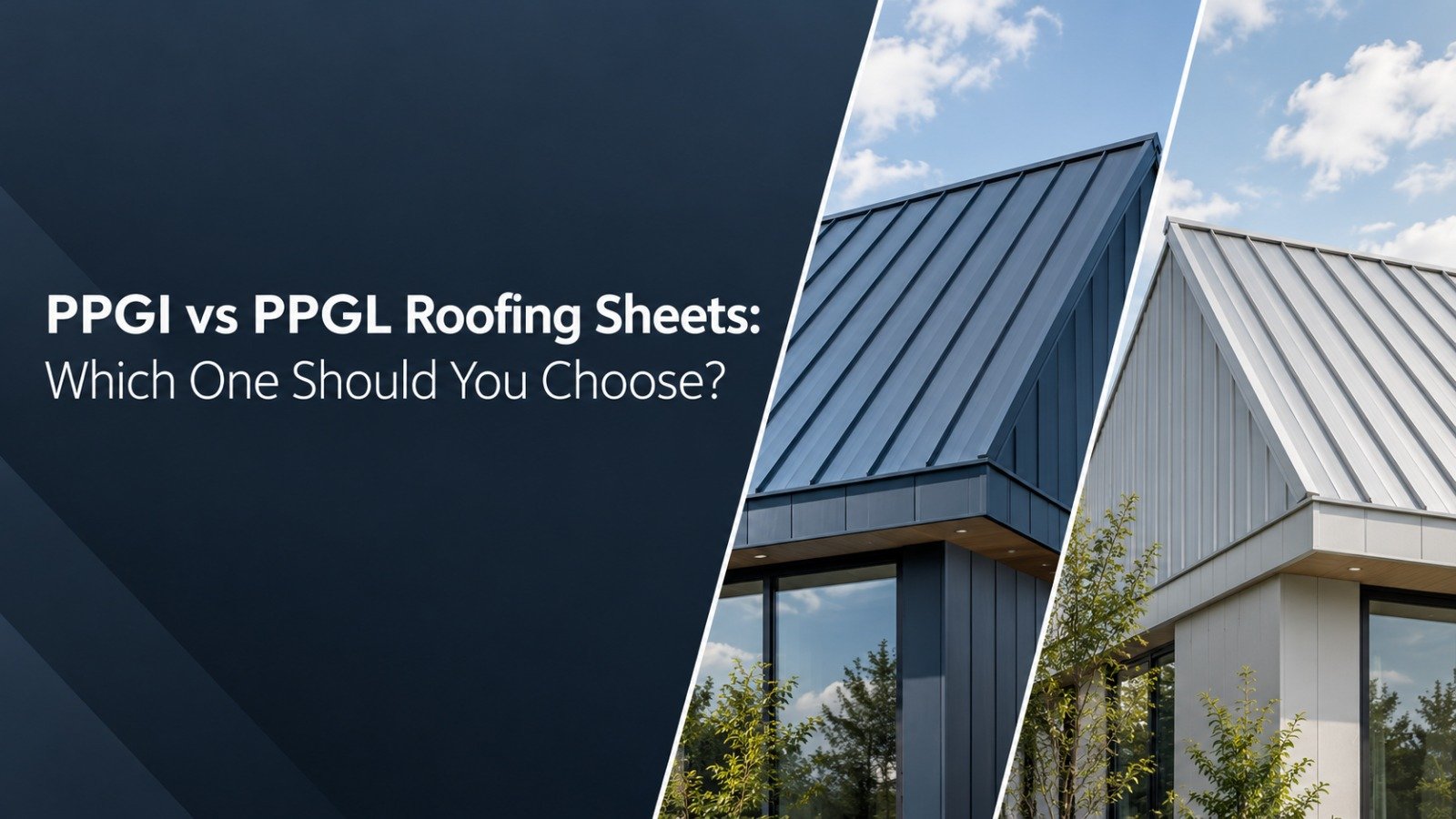
Two popular options in modern construction are PPGI roofing sheets and PPGL roofing sheets. At first glance, they may look almost identical. Both are available in a wide range of colours and finishes, and both combine the strength of steel with protective metallic and paint coatings.
But there is an important difference beneath the surface.
PPGI uses a zinc coating, while PPGL uses an aluminium-zinc alloy coating.
This difference affects how each sheet protects its steel substrate and how it performs under different environmental conditions.
So, when comparing PPGI vs PPGL roofing sheets, which one should builders, architects and project engineers choose?
The answer depends on the application, environment and required performance.
What Is PPGI Roofing Sheet?
PPGI stands for Pre-Painted Galvanised Iron/Steel.
The process begins with a steel substrate coated with zinc to provide protection against corrosion. The galvanised steel is then cleaned, treated and coated with an engineered paint system to provide the required colour, appearance and additional surface protection.
The result is a pre-painted galvanized steel roofing sheet that combines:
- The structural strength of steel
- Zinc-based corrosion protection
- A durable pre-painted surface
- A wide range of colours and finishes
Because the coating is applied in a controlled manufacturing environment before the sheet reaches the construction site, PPGI roofing sheets can offer a consistent and uniform finish.
Where Are PPGI Roofing Sheets Commonly Used?
PPGI roofing sheets can be suitable for a variety of applications, including:
- Residential roofing
- Commercial buildings
- Industrial sheds
- Warehouses
- Wall cladding
- Agricultural structures
- Architectural applications
For projects where appearance, versatility and dependable corrosion protection are important considerations, PPGI remains a widely used coated steel roofing solution.
What Is PPGL Roofing Sheet?
PPGL stands for Pre-Painted Galvalume/Aluminium-Zinc Coated Steel.
Instead of a predominantly zinc coating, the steel substrate receives an aluminium-zinc alloy coating.
The aluminium component contributes barrier protection against the surrounding environment, while zinc contributes sacrificial protection to exposed areas.
After the metallic coating process, the steel can be further processed with a pre-painted coating system to achieve the desired colour, finish and performance characteristics.
This combination makes PPGL roofing sheets relevant for applications where exposure to weather, heat and corrosion is an important consideration.
Why Is the Coating Important?
Think of the steel core as the structural backbone of the roofing sheet.
The metallic coating acts as its first line of defence.
The paint system then provides another protective layer while also contributing significantly to the sheet’s visual appearance and surface performance.
That means choosing between PPGI and PPGL roofing sheets is not simply about the product name.
The metallic coating, coating thickness, steel grade, paint technology and manufacturing quality all play an important role in determining the overall performance of the roofing system.
PPGI vs PPGL Roofing Sheets: What Is the Difference?
The fundamental difference between PPGI vs PPGL lies in the metallic coating applied to the steel substrate.
| Feature | PPGI Roofing Sheets | PPGL Roofing Sheets |
| Full form | Pre-Painted Galvanised Steel | Pre-Painted Aluminium-Zinc Coated Steel |
| Metallic coating | Primarily zinc | Aluminium-zinc alloy |
| Corrosion protection mechanism | Zinc provides barrier and sacrificial protection | Aluminium contributes barrier protection while zinc offers sacrificial protection |
| Surface finish | Wide range of colours and finishes | Wide range of colours and finishes |
| Heat performance | Influenced by colour and coating system | Strong reflective potential depending on coating and finish |
| Typical applications | Residential, commercial and industrial | Roofing, industrial, commercial and exposed applications |
| Maintenance | Depends on environment and installation | Depends on environment and installation |
The basic distinction is straightforward, but the more important question is:
What does this difference mean for your actual roofing application?
PPGI vs PPGL: Which Offers Better Corrosion Protection?
Corrosion is one of the biggest considerations when selecting a metal roofing sheet.
Rain, humidity, industrial pollutants, coastal air and prolonged exposure to moisture can gradually affect inadequately protected steel.
With PPGI roofing sheets, the zinc coating protects the steel through both barrier protection and sacrificial protection. Zinc can continue to provide protective action when small areas of the coating become exposed.
PPGL roofing sheets use an aluminium-zinc alloy coating. Aluminium contributes barrier protection, while zinc provides sacrificial protection. This combination is designed to provide robust protection in demanding outdoor applications.
However, it would be too simplistic to say that one material will always last longer than the other.
Actual roofing performance depends on the complete product and project specification.
Important factors include:
- Metallic coating mass
- Paint and coating system
- Steel grade
- Local climate
- Installation practices
- Water drainage
- Cut-edge treatment
- Maintenance
- Exposure to chemicals or pollutants
For architects and project engineers, the better question is therefore not simply:
“PPGI or PPGL?”
Instead, ask:
“Which coating specification is appropriate for this project’s exposure conditions?”
Does PPGL Reflect More Heat Than PPGI?
Thermal performance has become increasingly important in modern construction.
In hot climates, roofing sheets are continuously exposed to solar radiation. The choice of roofing system can therefore influence the thermal environment inside a building.
PPGL roofing sheets are often considered for applications where reflective performance is important because of the characteristics of their aluminium-zinc metallic coating.
But there is an important qualification.
Roof colour and the complete coating system also influence solar performance.
A light-coloured, highly reflective roofing surface can behave very differently from a dark-coloured surface, regardless of whether the substrate is PPGI or PPGL.
Other factors such as:
- Roof ventilation
- Insulation
- Building orientation
- Roof design
- Overall construction system
also influence the thermal performance of a building.
Therefore, rather than assuming that PPGL is automatically a “cooler” roofing solution, architects should evaluate the entire roofing system and its intended application.
PPGI vs PPGL: What About Service Life?
There is no single number that accurately describes the service life of every PPGI roofing sheet or PPGL roofing sheet.
Why?
Because a roof installed beside a humid coastline does not experience the same conditions as one installed in a relatively dry inland environment.
Similarly, an industrial building exposed to pollutants may have very different requirements from a residential structure.
The service performance of a coated roofing sheet depends on factors such as:
- Environmental exposure
- Metallic coating specification
- Paint coating system
- Steel quality
- Installation practices
- Water drainage
- Fabrication and handling
- Maintenance
- Exposure to chemicals and pollutants
This is why buyers should avoid selecting a roofing sheet based solely on an assumed lifespan.
Instead, the right approach is to evaluate the coating system and application requirements together.
PPGI vs PPGL: Which Roofing Sheet Is Right for Your Project?
There is no universal winner in the PPGI vs PPGL roofing sheets comparison.
The right choice depends on what the project actually requires.
Choose PPGI When:
PPGI roofing sheets may be considered when the project requires:
- A versatile pre-painted steel solution
- A wide range of colours and finishes
- Reliable zinc-based corrosion protection
- Residential or commercial roofing
- Industrial and architectural applications
- A roofing solution aligned with the project’s specified coating requirements
Consider PPGL When:
PPGL roofing sheets may be considered when the project places greater emphasis on:
- Aluminium-zinc coated steel
- Outdoor exposure
- Corrosion protection requirements
- Reflective performance considerations
- Industrial or commercial roofing
- Applications where the specified coating system is suited to the environment
The final selection should always be based on the project specification, environmental conditions and required performance, rather than choosing solely by product name.
What Should Buyers Check Before Choosing Roofing Sheets?
Whether you are considering PPGI or PPGL roofing sheets, there are several factors worth evaluating before placing an order.
1. Understand the Environment
Consider whether the building is located in:
- A dry inland region
- A humid environment
- A high-rainfall area
- A coastal region
- An industrial area
Environmental exposure can significantly influence the requirements of the roofing sheet coating.
2. Check the Metallic Coating
Understand whether the product uses a zinc coating or an aluminium-zinc coating, and verify the applicable coating specification.
3. Consider the Paint System
The paint system influences colour retention, surface appearance and additional protection.
A good-looking roofing sheet is important, but its coating system also needs to be appropriate for the intended environment.
4. Evaluate Steel Grade and Thickness
The structural requirements of the project should determine the appropriate steel grade and sheet thickness.
5. Consider Roof Colour
Colour can influence the visual appearance and thermal behaviour of the roof.
Light and reflective colours may perform differently from darker colours under strong solar exposure.
6. Review Installation Practices
Even a high-quality coated steel roofing sheet can have its performance affected by poor installation.
Fastening, cutting, handling, drainage and protection of exposed areas should all be considered.
7. Evaluate Manufacturing Quality
Consistent manufacturing and quality control are essential.
The metallic coating, paint system, steel substrate and overall product quality should work together to deliver dependable roofing performance.
PPGI vs PPGL Roofing Sheets: Quick Comparison
PPGI Roofing Sheets
→ Pre-painted galvanised steel
→ Primarily zinc-based metallic coating
→ Provides barrier and sacrificial protection
→ Available in a wide range of colours and finishes
→ Suitable for residential, commercial and industrial applications
→ Performance depends on coating, environment and installation
PPGL Roofing Sheets
→ Pre-painted aluminium-zinc coated steel
→ Aluminium-zinc metallic coating
→ Aluminium contributes barrier protection while zinc provides sacrificial protection
→ Available in a wide range of colours and finishes
→ Suitable for roofing and exposed applications
→ Reflective performance can be an important consideration
→ Performance depends on coating, environment and installation
The key takeaway:
PPGI vs PPGL is not simply a choice between “good” and “better.”
It is a choice between different coating systems designed for different project requirements.
Why Manufacturing Quality Matters
The performance of a PPGI or PPGL roofing sheet depends not only on the name of the product but also on how consistently it is manufactured.
For industrial buyers, this means looking at the relationship between:
Steel substrate + metallic coating + paint system + processing + quality control + application
At Manaksia Steels, coated steel solutions are manufactured with the requirements of modern construction and industrial applications in mind.
The objective is not simply to offer a roofing sheet in a particular colour or coating specification.
It is to provide coated steel products that meet the required technical parameters consistently and are suited to their intended application.
For projects where corrosion resistance, durability, appearance and material reliability matter, choosing the right roofing sheet specification is an important part of responsible material selection.
Frequently Asked Questions
Is PPGI better than PPGL?
Neither is automatically better for every project. PPGI vs PPGL roofing sheets should be evaluated based on the environment, coating specification, application, required performance and project requirements.
What is the difference between PPGI and PPGL?
The main difference is the metallic coating. PPGI roofing sheets use a primarily zinc-based coating, while PPGL roofing sheets use an aluminium-zinc alloy coating.
Which is better for roofing, PPGI or PPGL?
The right choice depends on the project. PPGI and PPGL roofing sheets can both be suitable for roofing applications when the product specification matches the environmental and performance requirements.
Is PPGL suitable for hot climates?
PPGL roofing sheets can be considered for applications where reflective performance is important. However, roof colour, paint system, insulation, ventilation and overall building design also influence thermal performance.
Which roofing sheet is more corrosion resistant?
Corrosion performance depends on the complete coating system, environmental exposure, coating specification, installation and maintenance. It is therefore not advisable to judge PPGI vs PPGL corrosion resistance using the material name alone.
Are PPGI and PPGL available in different colours?
Yes. Both PPGI roofing sheets and PPGL roofing sheets can be produced with a range of colours and finishes, depending on the product and coating system.
What should I consider before buying PPGI or PPGL roofing sheets?
Consider the steel grade, sheet thickness, metallic coating, paint system, environmental exposure, roof design, installation requirements and manufacturer quality before making a decision.
PPGI vs PPGL: Choose the Right Roofing Sheet for the Right Application
When comparing PPGI vs PPGL roofing sheets, the difference may initially appear to be a technical detail.
But the choice of metallic coating can influence how the roofing sheet responds to its environment and performs over time.
PPGI roofing sheets offer the advantages of zinc-based protection combined with a pre-painted surface, making them a versatile option across residential, commercial and industrial applications.
PPGL roofing sheets combine an aluminium-zinc metallic coating with a pre-painted surface and can be considered for applications where exposure, corrosion protection and reflective performance are important considerations.
Ultimately, there is no one-size-fits-all answer.
Understand the environment. Check the coating specification. Consider the roofing system. Evaluate the manufacturer. Then choose the product that fits the application.
Because the best roofing sheet is not necessarily the one with the biggest specification—it is the one that delivers the right balance of protection, performance, appearance and value for the project.
Choose the right coated steel solution for your next roofing or construction project with Manaksia Steels.