When buying galvanized steel, industrial buyers naturally look at the basics first: steel grade, thickness, dimensions and price.
But there is another specification that deserves just as much attention—GSM.
You may come across specifications such as 80 GSM galvanized steel, 100 GSM or 120 GSM galvanized steel while sourcing steel for construction or industrial applications. At first glance, the difference may seem small. But GSM represents something important: the zinc coating weight applied to the steel surface.
When steel is expected to withstand years of rain, humidity, pollution or coastal exposure, the galvanized steel coating becomes an important part of its corrosion protection strategy.
So, when should an industrial buyer choose 80 GSM vs 120 GSM galvanized steel? And which zinc coating weight is more suitable for a particular application?
The answer starts with understanding what GSM actually means.
What Does GSM Mean in Galvanized Steel?
GSM stands for grams per square metre.
In galvanized steel, GSM indicates the mass of zinc coating per unit area of the steel surface. In simple terms, it helps buyers understand how much zinc has been applied to the steel.
Generally:
Higher coating weight = more zinc available to provide corrosion protection, all other factors being equal.
Therefore, 80 GSM galvanized steel has a lower zinc coating weight than 120 GSM galvanized steel.
However, buyers should not treat GSM as a direct guarantee of service life. The performance of zinc coated steel depends on several factors, including the coating specification, steel quality, atmospheric conditions, fabrication, installation and maintenance.
The zinc coating is an important part of the protection system—but it is not the entire equation.
Why Does Zinc Protect Steel?
Steel is strong, versatile and widely used across construction and industrial applications. However, untreated steel can be vulnerable to corrosion when exposed to moisture and oxygen.
Galvanization helps address this problem by applying a protective zinc coating for steel.
Zinc protects the underlying steel in two important ways.
1. Barrier Protection
The zinc layer creates a barrier between the steel and the surrounding environment, reducing direct exposure to moisture and atmospheric elements.
2. Sacrificial Protection
Zinc is more chemically active than steel. If a small area of the coating is damaged or exposed, zinc can preferentially corrode and help protect the exposed steel under many conditions.
This sacrificial protection is one of the key reasons galvanized steel for corrosion protection is widely used across demanding industrial and construction applications.
80 GSM vs 120 GSM Galvanized Steel: What Actually Changes?
The most obvious difference between 80 GSM and 120 GSM galvanized steel is the amount of zinc coating.
| Parameter | 80 GSM Galvanized Steel | 120 GSM Galvanized Steel |
| Zinc coating weight | Lower | Higher |
| Zinc available for protection | Lower | Higher |
| Relative coating thickness | Lower | Higher |
| Potential corrosion protection | Good when appropriately specified | Greater coating reserve, subject to environment |
| Suitable application | Lower-to-moderate exposure applications | Moderate-to-more demanding exposure applications |
| Key buyer consideration | Application and climate | Application, climate and required durability |
The important point is that 120 GSM galvanized steel does not automatically mean it is better for every project.
The right galvanized steel coating weight depends on where the material will be installed, the environmental conditions and the required performance.
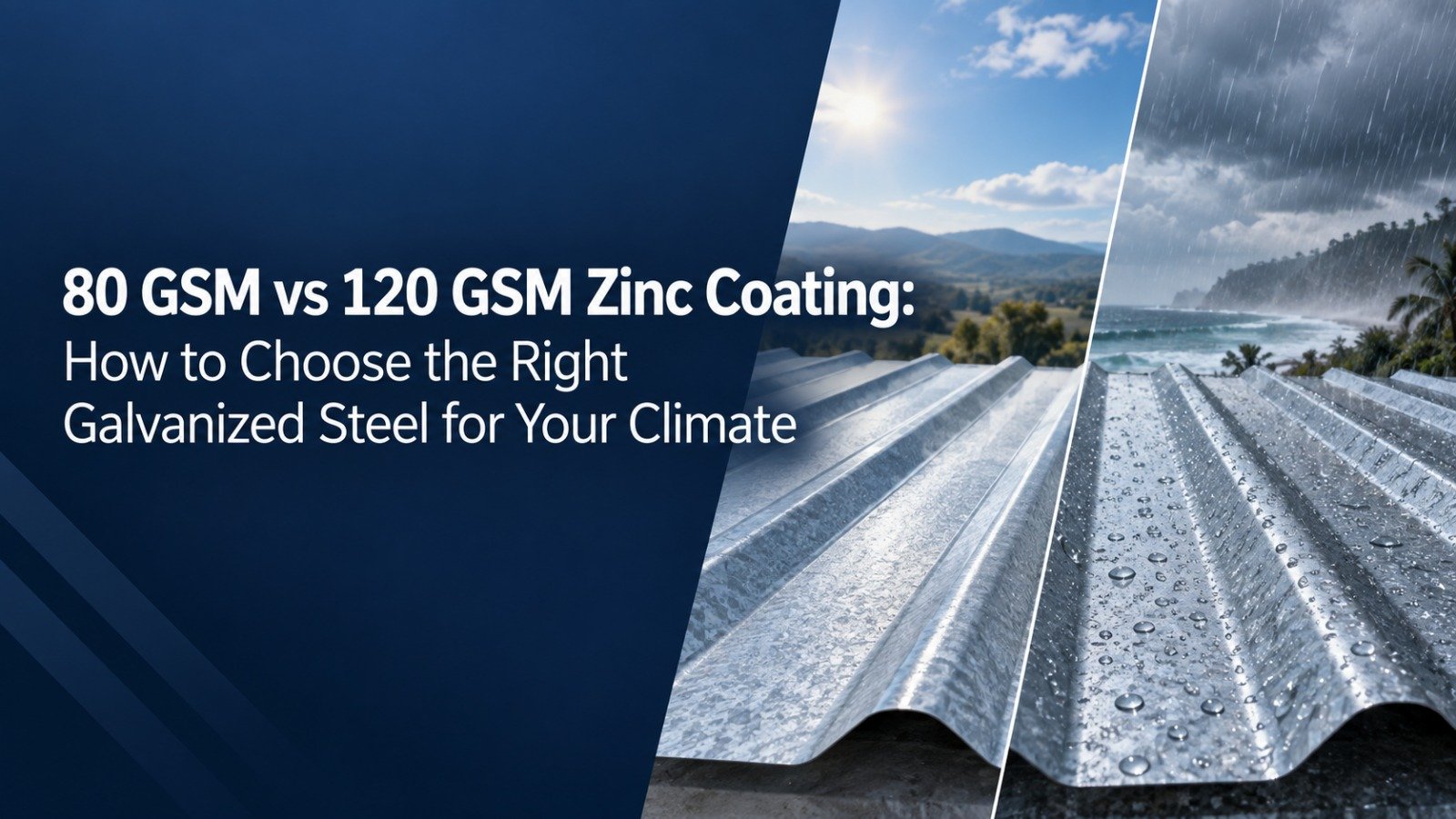
Why Climate Matters When Choosing Zinc Coating Weight
Imagine two steel structures.
One is located in a relatively dry inland environment. The other is positioned in a humid coastal region where the atmosphere contains salt-laden moisture.
They may look identical on paper, but their corrosion exposure is not the same.
That difference should influence the selection of galvanized steel coating.
Dry and Lower-Exposure Environments
In relatively mild atmospheric conditions, a lower coating specification such as 80 GSM galvanized steel may be appropriate for certain applications, provided it meets the required product standard and project specification.
Potential applications may include:
- Indoor industrial structures
- Certain dry-environment components
- Light fabrication
- General engineering applications
- Applications with limited atmospheric exposure
However, the decision should always be based on the required specification rather than simply choosing the lowest zinc coating weight.
Humid and High-Rainfall Regions
Humidity and frequent rainfall increase the opportunity for moisture to interact with the steel surface.
For outdoor structures in such environments, buyers may consider a higher zinc coating weight where the application and applicable standard call for it.
A 120 GSM zinc coating provides a greater quantity of zinc available for protective action compared with an 80 GSM coating.
However, drainage, water retention, design details and installation quality remain important considerations when evaluating galvanized steel durability.
Coastal and Salt-Laden Environments
Coastal environments can be particularly challenging for steel because of salt-containing moisture.
For such applications, corrosion protection for galvanized steel needs to be treated as a complete system rather than relying on a single specification.
Buyers should evaluate:
- Zinc coating weight
- Steel grade
- Product standard
- Environmental exposure category
- Paint or additional protective systems where applicable
- Edge and cut-area protection
- Fabrication practices
- Maintenance requirements
For more aggressive environments, selecting a higher galvanized steel coating weight may provide additional protective reserve, but the complete corrosion protection system must be considered.
Does 120 GSM Last 50% Longer Than 80 GSM?
This is a common assumption—but it is not that simple.
A 50% increase in zinc coating weight does not mean the steel will automatically provide 50% more service life.
Why?
Because corrosion rates vary significantly depending on environmental conditions.
The same galvanized steel coating can behave differently depending on:
- Humidity
- Rainfall
- Salt exposure
- Industrial pollution
- Temperature
- Wetness duration
- Surface condition
- Product geometry
- Installation
- Maintenance
Therefore, GSM should be viewed as one of the important factors influencing galvanized steel durability, rather than a simple mathematical prediction of lifespan.
80 GSM vs 120 GSM: A Buyer’s Decision Framework
Instead of asking:
“Which one is cheaper?”
Industrial buyers should ask:
“What level of corrosion protection does this application actually require?”
A practical decision framework looks like this:
Step 1: Identify the Environment
Is the steel going indoors, outdoors, near the coast, in a humid region or in an industrial atmosphere?
Step 2: Understand the Exposure
Will the steel remain dry most of the time, or will it regularly experience rain, condensation or moisture?
Step 3: Define the Required Service Performance
How long is the structure expected to perform, and what level of maintenance is practical?
Step 4: Check the Applicable Specification
Don’t select galvanized steel GSM in isolation. Verify the applicable product standard, coating designation and project requirements.
Step 5: Consider Fabrication and Installation
Cutting, drilling, welding, bending and handling can affect protective performance. Damaged areas may require appropriate treatment depending on the product and application.
Step 6: Compare Total Value
A lower initial material cost may not represent better value if the application demands a higher level of corrosion protection for galvanized steel.
80 GSM vs 120 GSM Galvanized Steel: Quick Comparison
80 GSM Galvanized Steel
→ Lower zinc coating weight
→ Suitable for applications where the specified exposure permits it
→ Can be appropriate for selected mild or controlled environments
→ Lower coating reserve compared with 120 GSM
120 GSM Galvanized Steel
→ Higher zinc coating weight
→ Greater zinc coating reserve
→ Worth considering for applications with higher exposure requirements
→ Can provide additional protection potential, subject to the environment and specification
Remember:
GSM ↑ → Zinc coating ↑ → Protective reserve ↑
But:
Coating weight alone ≠ Guaranteed service life
Is More Zinc Always Better?
Not necessarily.
This is where experienced material selection matters.
A higher zinc coating weight can provide additional zinc, but the most appropriate specification is the one that balances corrosion exposure, application requirements, standards, fabrication needs and project economics.
For example, specifying an unnecessarily high coating weight for a controlled indoor application may not deliver meaningful additional value.
Conversely, choosing a lower coating weight simply to reduce procurement cost in a highly exposed environment could be a false economy.
The objective should be fit-for-purpose corrosion protection.
What Industrial Buyers Should Check Before Ordering Galvanized Steel
Before placing an order, procurement teams should look beyond the GSM figure.
Check the Steel Grade
The mechanical and structural requirements of the application must be satisfied.
Confirm the Zinc Coating Specification
Make sure the stated galvanized steel coating weight corresponds to the required product standard and specification.
Ask About Coating Uniformity
Consistent coating across the product is important for predictable performance.
Consider the Environment
A coastal project, an industrial facility and an indoor application do not necessarily require the same galvanized steel coating approach.
Review Fabrication Requirements
Bending, cutting, welding and other processes should be considered when evaluating the complete corrosion protection strategy.
Evaluate the Manufacturer
Consistency in manufacturing and quality control matters just as much as the specification written on the purchase order.
Why Manufacturing Quality Matters
A zinc coating specification only delivers value when the product is manufactured consistently.
For industrial buyers, this means looking for a manufacturer that understands the relationship between:
Steel substrate + zinc coating + processing + quality control + application
At Manaksia Steels, galvanized and coated steel solutions are manufactured with the requirements of modern industrial and construction applications in mind.
The objective is not simply to put a number such as 80 GSM or 120 GSM on a specification sheet. It is to deliver coated steel that meets the required technical parameters consistently and performs appropriately for its intended application.
For projects where corrosion resistance, durability and material reliability matter, choosing the right galvanized steel coating specification is an important part of responsible steel procurement.
Frequently Asked Questions
What is 80 GSM in galvanized steel?
80 GSM galvanized steel refers to a zinc coating weight of 80 grams per square metre, subject to the specific product and applicable measurement convention or standard.
What does 120 GSM mean?
120 GSM galvanized steel indicates a higher zinc coating weight than 80 GSM. It provides a greater quantity of zinc coating per unit area, which can provide greater protective reserve under suitable conditions.
Is 120 GSM better than 80 GSM?
Not automatically. 120 GSM galvanized steel provides more zinc coating, but the appropriate specification depends on the environment, application, product standard and required service performance.
Which GSM is better for coastal areas?
Coastal areas can involve aggressive salt-laden exposure. A suitable galvanized steel coating specification should therefore be selected based on the relevant environmental conditions and applicable standards.
A higher zinc coating weight may be appropriate for some applications, but the complete corrosion protection system should be evaluated.
Does higher GSM mean longer life?
Higher coating weight generally provides more zinc available for corrosion protection, but service life cannot be predicted from GSM alone.
Environmental exposure, coating quality, installation and maintenance all influence the performance and durability of galvanized steel.
Should buyers choose galvanized steel based only on GSM?
No.
Buyers should consider steel grade, zinc coating specification, applicable standards, coating uniformity, environmental exposure, fabrication requirements and manufacturer quality alongside GSM.
The Right GSM Is About the Right Application
When purchasing galvanized steel, the difference between 80 GSM vs 120 GSM galvanized steel may look like a small technical detail.
In reality, it represents a decision about how much protective zinc the steel carries into its service environment.
For a controlled application, 80 GSM galvanized steel may be sufficient when supported by the relevant specification.
For applications facing greater atmospheric exposure, a higher coating weight such as 120 GSM galvanized steel may offer additional protective reserve.
But the smartest procurement decision is rarely based on one number alone.
Assess the climate. Understand the exposure. Check the specification. Then choose the zinc coating weight that fits the application.
Because in galvanized steel, the cheapest option is not always the most economical one—and the highest specification is not always the most appropriate one.
Choose galvanized steel with the right specification for the environment, and choose a manufacturer you can rely on for consistent quality.
Explore Manaksia Steels’ galvanized and coated steel solutions for your next industrial or construction project.